
Why Hyperscale Data Centers Fall Behind Schedule (and How to Prevent It)
Hyperscale data centers (those housing 5,000+ servers) are experiencing rapid growth this year, primarily driven by the booming demand for artificial intelligence (AI), machine learning, and cloud services.
As AI adoption continues to expand, the need for vast amounts of computing power and low-latency data access will expand with it. Unfortunately, legacy enterprise data centers cannot efficiently support this demand, leading to the creation of new centers (“hyperscale”) that offer:
- High-speed connectivity to support large data flows
- Extreme electrical and cooling capacities for power-hungry hardware
- Modular, automated infrastructure for fast deployment
- Advanced redundancy and self-healing features to minimize downtime
One example of these new hyperscale data centers is right in our own backyard. Pennsylvania Digital I (PAX). This is a $15 billion joint venture by Pennsylvania Data Center Partners and PowerHouse Data Centers to build three hyperscale campuses in Carlisle, PA, delivering 1.35 GW of capacity with scalability to 1.8 GW.
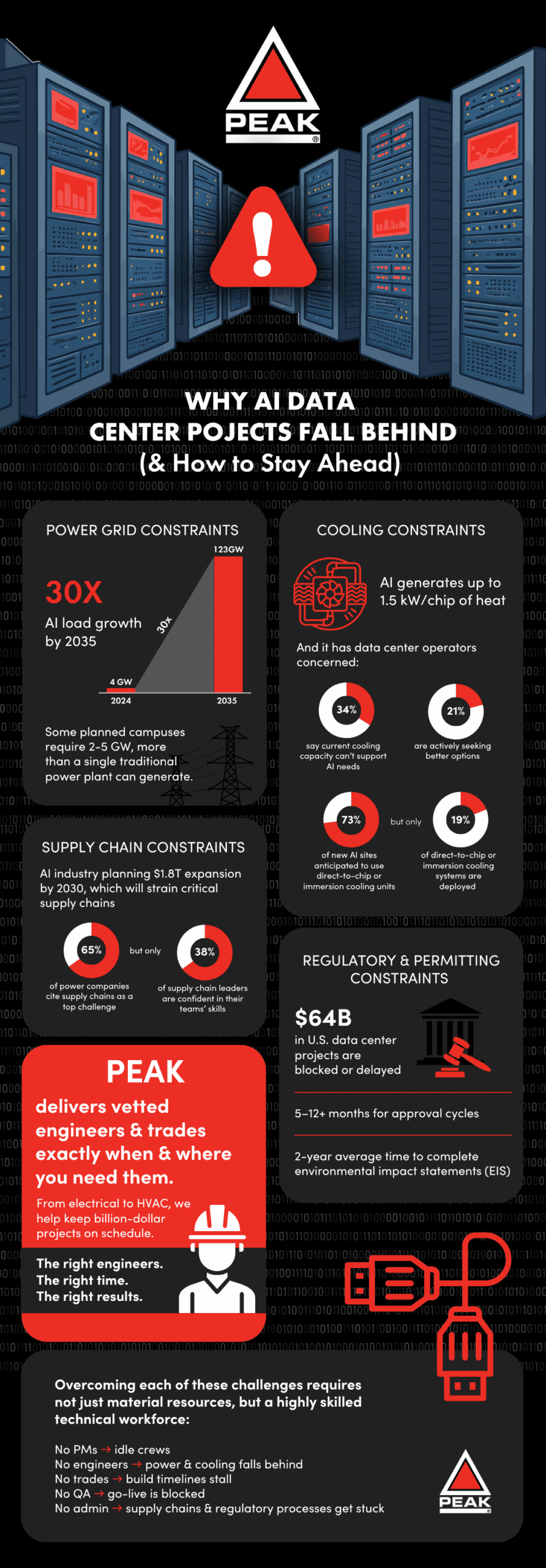
However, hyperscale data center projects (in PA or elsewhere) are notorious for falling behind schedule. Let’s look at why that’s the case, and how proactive workforce planning is critical to keeping projects rolling on time.
Key Takeaways
- Delays are common, but preventable. Hyperscale data centers often run behind due to power constraints, regulatory red tape, supply chain issues, and workforce shortages, but these risks can be managed with the right planning.
- Workforce readiness is critical. Even with land, permits, and materials secured, projects stall without enough skilled talent to meet deadlines—making proactive labor planning just as important as equipment and infrastructure.
- Smart strategies keep builds on track. Multi-tier scheduling, real-time project management tools, predictive analytics, and strong vendor partnerships help leaders anticipate challenges and maintain momentum.
How Do Hyperscale Data Centers Work?
The primary difference between hyperscale data centers and their traditional counterparts is size. This is partly because of the sheer volume of data processing that takes place within these facilities, and also because of the amount of redundancy needed to maintain smooth operations.
Ranging from at least at 5,000 to as many as millions of servers, hyperscale data centers are massive and potentially span millions of square feet. Specific components include the compute and storage systems themselves, networking gear, power and cooling systems, modular architecture, security layers, and more.
What Goes into Building and Maintaining a Hyperscale Data Center?
Given the size of these facilities, it shouldn’t be surprising that building a hyperscale data center is a complex, multi-year process. Each step requires a diverse set of skills and support to bring it to fruition. Once the facility is complete, it then requires an equally diverse array of skills to operate it.
As such, hyperscale data centers are engines of job growth, not just in terms of direct employment, but in the second- and third-order effects on the local economy. Here’s just a sampling of the talent needed to build and operate these facilities:
| Site Selection & Design | Site analysts, energy consultants, environmental scientists, civil engineers, and legal advisors
|
| Permitting & Approvals | Legal specialists and compliance professionals
|
| Architectural & Engineering Design | Architects; structural, electrical, and mechanical engineers; sustainability consultants
|
| Construction & Fit-Out | Project managers, general contractors, skilled tradespeople (electricians, HVAC, plumbers, carpenters), steelworkers, heavy machinery operators, and logics & supply chain professionals
|
| Systems Integration & MEP | Mechanical, electrical, and plumbing (MEP) engineers and IT professionals.
|
| Commissioning & Testing | QA engineers, commissioning agents, and specialized testing teams. |
Once the facility is up and running, a hyperscale data center requires the following personnel to maintain its operations:
- Facility and operations managers to oversee daily site operations and ensure safety and compliance across all teams
- Data center technicians and engineers who maintain server hardware, troubleshoot issues, and perform upgrades
- Electrical and mechanical engineers, who are responsible for power distribution units, generators, cooling systems, and routine preventive maintenance
- Security professionals, including cybersecurity experts, access control professionals, and surveillance technicians
- IT infrastructure and network engineers to oversee connectivity and handle performance, redundancy, and scaling
- Environmental and sustainability engineers who monitor the data center’s carbon footprint and manage renewable energy targets
- Cloud and AI specialists to aid in GPU server setup, cluster management, and distributed computing
Why Do Hyperscale Data Centers Fall Behind Schedule?
Building a hyperscale data center is a complex, multi-year undertaking. A single delay in permitting, equipment delivery, or workforce availability can snowball into months or years of lost time. Here are the most common reasons why these projects often fall behind schedule.
Overoptimistic Project Timelines
At the planning stage, developers often assume construction will move faster than reality allows. What looks like a two-year build on paper can easily stretch into three or more. The impacts of these forecasting errors often ripple out into higher costs, idle resources, and dissatisfaction among investors and customers.
Power Grid and Transmission Constraints
One of the toughest challenges in today’s data center markets is the ability to generate sufficient power to operate them. Available land doesn’t mean available grid capacity. It often takes years to design and build new transmission infrastructure, which in turn delays project start dates or causes work to pause midstream.
Permitting and Regulatory Delays
Local governments, environmental agencies, and community groups all have a say in whether (and how) these projects move forward. Approvals that once took months now often stretch into years as regulatory processes grow more complex.
Supply Chain and Material Bottlenecks
From generators and cooling units to steel and fiber, supply chains remain a fragile link in the process. Disruptions in global manufacturing or transportation can derail tightly sequenced build schedules, leaving teams waiting for critical components.
Workforce Shortages
Even when the power is secured and the materials are on-site, projects still depend on people. We’ve already seen how certain markets are seeing shortages in technical talent due to a rapid growth in demand. These shortages slow progress when you need the most momentum, causing data centers to fall behind schedule.
How to Prevent Your Hyperscale Data Center from Falling Behind Schedule
Delays in hyperscale data centers may be inevitable, but that doesn’t mean they aren’t manageable. The projects that finish on time are run by those who anticipate risks early, build flexibility into their plans, and prioritize workforce readiness to the same degree as equipment and infrastructure. Here are four strategies that can help keep complex builds on track.
1. Multi-Tier Construction Scheduling
Instead of working in rigid, linear phases, successful data center projects adopt a multi-phase, parallel scheduling approach. Civil engineering, electrical installation, cooling infrastructure, and IT deployment can all move forward concurrently. This structured approach helps to reduce idle time, prevent bottlenecks, and ensure teams stay aligned as milestones overlap.
2. Real-Time Project and Workforce Management Tools
Centralized project management platforms bring transparency to an otherwise fragmented process. By consolidating scheduling, vendor updates, and workforce allocation into one system, project leaders gain real-time visibility into progress. Automated alerts flag potential conflicts early, while shared dashboards keep contractors, suppliers, and project managers working from the same playbook.
3. AI and Predictive Analytics
AI is transforming how project risks are managed. By analyzing historical data alongside real-time inputs, predictive models can forecast issues such as supply chain slowdowns or labor shortages before they disrupt schedules. This allows managers to reallocate resources, adjust staffing, or re-sequence workflows.
4. Strong Vendor and Workforce Management
At the end of the day, even the best planning tools can’t make up for a workforce that isn’t there. Effective vendor coordination, consistent communication, and proactive labor planning are essential. The projects that stay on schedule are the ones that not only secure skilled workers early but also create conditions that keep them engaged and retained throughout the build.
Final Thoughts
Hyperscale data centers are the backbone of today’s AI and cloud-driven economy. But without proactive planning, especially when it comes to your workforce, it’s easy for these projects to fall behind.
Having the right workforce strategy (and partners) in place will help you to anticipate hiring needs, secure skilled labor, and reduce turnover risk. This, ultimately, is what keeps projects moving forward.
Learn more about how PEAK supports data center projects with our total talent management solutions.